The Stepping Stone Problem
The mistake isn't playing small venues. The mistake is treating them like a stepping stone instead of a destination.
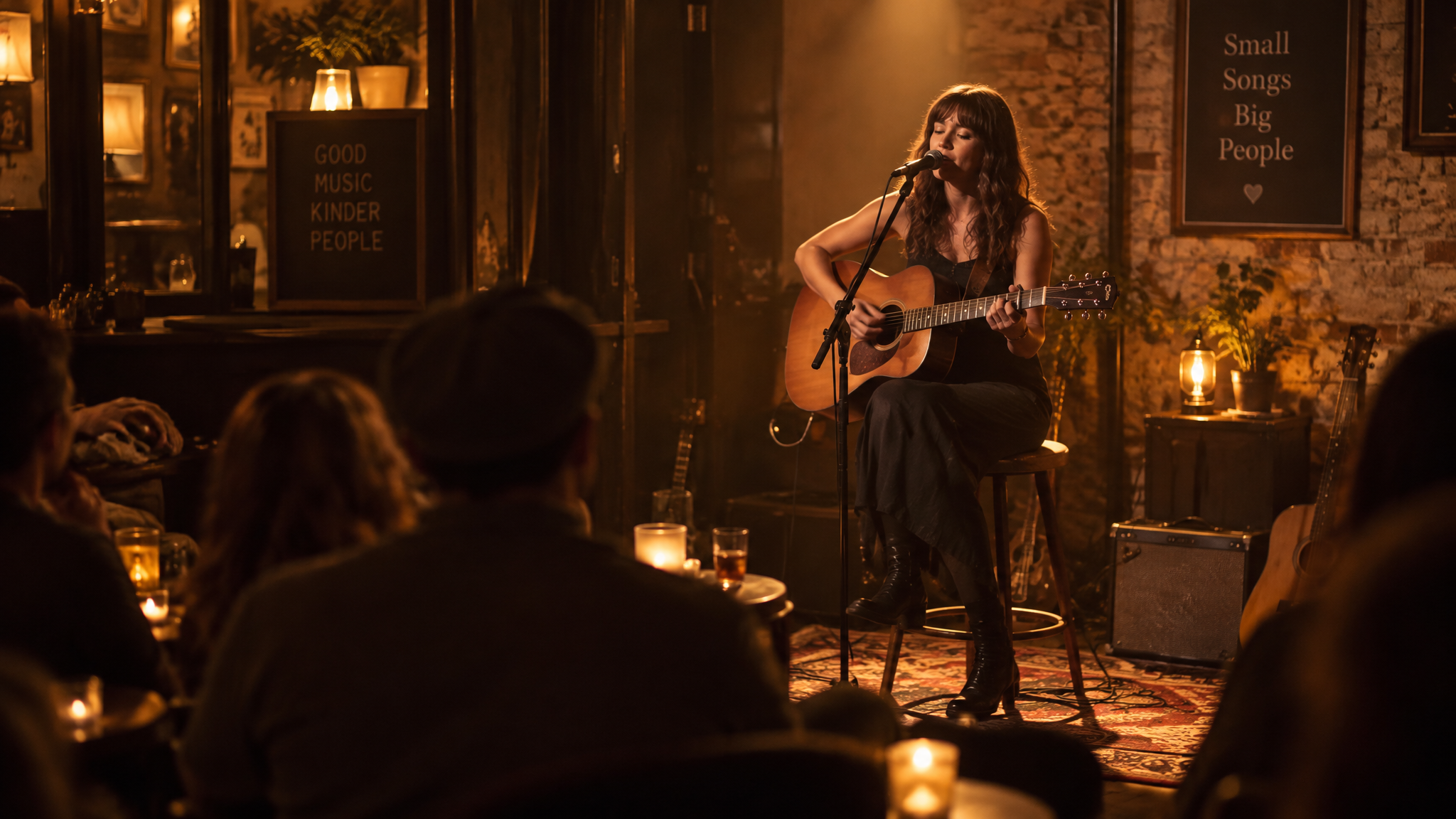
I've watched a lot of singer-songwriters play small rooms — coffee shops, listening rooms, bars with a corner stage — and the ones who are clearly thinking about the next, bigger thing are almost always worse than the ones who are fully present in the room they're in. The audience can feel it. The performance has a quality of waiting, of not quite being here yet, that undermines everything.
What Small Venues Actually Are
A small venue is an intimate venue. That's not a consolation prize — it's a specific kind of performance opportunity that larger venues can't replicate. In a room of fifty people, you can make eye contact. You can hear someone laugh at something you said. You can feel the room shift when a song lands.
That feedback loop is valuable. It teaches you things about your songs and your performance that you can't learn from a recording or from playing to a large crowd where the individual responses blur into a general noise. The small room is a laboratory. The singer-songwriters who understand this use it as one.
The experimental music world has a version of this — the idea that constraints produce creativity, that the limitations of a small setup force you to find solutions you wouldn't find otherwise. The small venue is a constraint. Work with it.
The Specific Mistakes
Talking too much between songs. This is the most common one. In a large venue, the between-song patter fills space and gives the audience a moment to breathe. In a small room, it often kills the momentum. The audience is close enough to see you thinking. They don't need the explanation. They need the next song.
Playing the same set you'd play anywhere. Small rooms reward specificity. If you know the venue, if you know something about the audience, if you can make the set feel like it was made for this room on this night — that's the thing. The generic set is fine. The specific set is memorable.
Not using the room. Small venues have acoustics. They have corners and ceilings and surfaces that affect the sound in ways that a large venue's PA system overrides. Some of the best small-room performances I've seen involved the performer moving around the space, using the room as an instrument. Most performers stand at the microphone and don't think about this at all.
What the Good Ones Do
They arrive early and listen to the room. They play a few notes, a few chords, and hear how the space responds. They adjust. They talk to the people running the venue and find out what the room is good at and what it isn't.
They treat the audience like people, not like a crowd. In a room of fifty, you can do this. You can notice the person in the corner who's really listening. You can play to them. You can make the performance feel like a conversation rather than a presentation.
The music culture conversation tends to focus on the big moments — the festival slots, the label deals, the streaming numbers. The small venue is where the actual work happens. It's where you figure out what your songs are and what you are as a performer. The artists who skip this phase, who go from bedroom recordings to larger stages without the small room education, often have a specific kind of fragility in their live performance. They haven't been tested in the intimate way.
The travel and culture of touring small venues is its own education — the different rooms in different cities, the way a song plays differently in a listening room in Nashville versus a bar in Portland. That education is worth having. More on the singer-songwriter world at Jeremy Dean Music.